
Anomalieerkennung in Kleegras mittels maschinellem Lernen
Anomaly detection, an AI method suited for open world settings and settings with limited training data, is adapted to the agricultural domain to explore its potential for the management of grass-clover meadows.
Author: Gerrit Lange
Supervisors: Prof. Dr. Stefan Stiene, Maik Fruhner
Type: Master Thesis
Period: 09 Sept 2024 – 09 Feb 2025
Abstract
Processing clover grass meadows for human consumption requires the detection of unwanted plants before or during harvest. Deep learning based anomaly detection presents a potential approach to solve this task, having shown promising results in other domains, but has not been evaluated in the agricultural domain. In this study the “Outlier Probability Based Feature Adaptation on contaminated data“ method presented in (Zhou & Wu, 2024) was reimplemented, adapted and evaluated for anomaly detection in grass clover. The Method is based in a feature extractor, a feature adaptor trained based on contrastive learning using LoOP (Kriegel et al., 2009) scores, a gaussian mixture model based memory bank and distance based scoring. A modified GrassClover dataset (Skovsen et al., 2019) is used for training and evaluation. Performance evaluation on MVTec AD (Bergmann et al., 2019) show a reduced AUROC of 0.9427 compared to the reported results in (Zhou & Wu, 2024). The performance further degrades to AUROC 0.5333 when evaluated on the modified GrassClover dataset. Fine-tuning of the feature extractor on the DeepWeeds dataset (Olsen et al., 2019) using cross entropy loss and supcon loss as well as tuning of hyperparameters allow an increase of AUROC to 0.6522. The use of a swin-transformer based feature extractor, regularization with von Neumann entropy and the modification of the used score function fail to further increase performance in anomaly detection. Complementing the training with synthetic anomalies could not be implemented successfully. It can be concluded that the adaptation of anomaly detection into the grassland domain poses significant challenges that are not addressed by methods that work in the general plant detection setting.
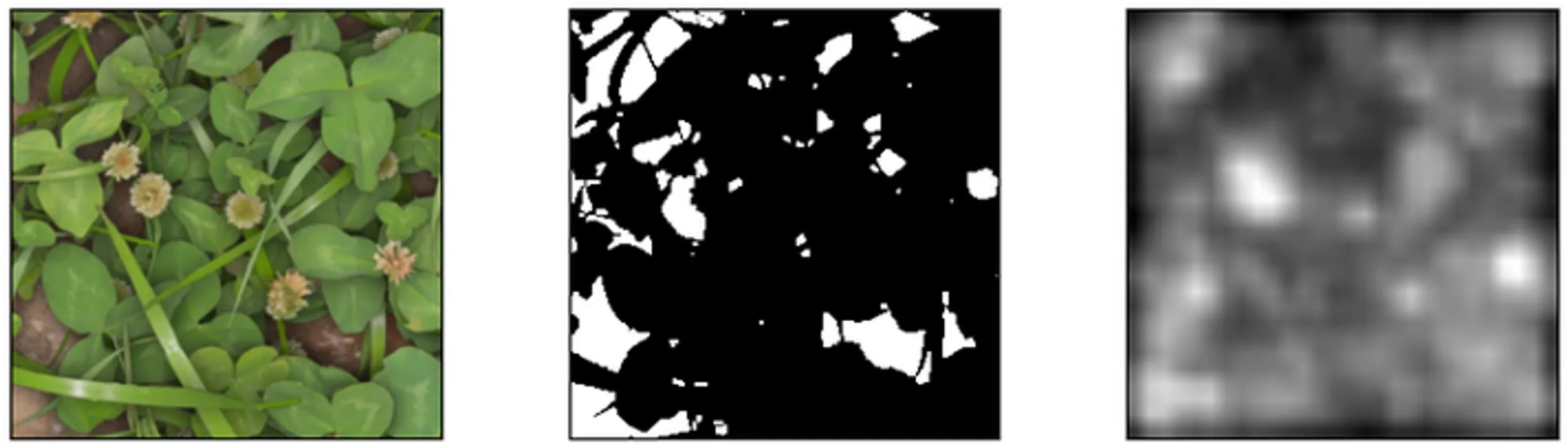 Figure 1: Synthetic grass-clover-meadow from (Skovsen et al., 2019), the corresponding ground truth for anomaly detection and the generated anomaly score map of a modified OPFA network.